

Terrain® is our service for timely insights on topics and trends impacting agriculture, delivered by a team of specialized economic and agriculture analysts. Additional Terrain articles can be found at TerrainAg.com.
Authors: Ben Laine
Report snapshot
Situation
With an average decline of about 5% each year since 1992, the U.S. has lost more than 100,000 dairy farms in just over a generation.
Finding
Fewer farms does not mean less milk. The U.S. dairy industry produced 231.7 billion pounds of milk in 2025. That’s 54% more milk than in 1992 despite having 190,238 fewer cows on 107,900 fewer farms — a stunning improvement in efficiency.
Impact
Because consolidation changes how milk supply responds to markets and who holds leverage along the supply chain, producers will need to prepare to adapt accordingly.
Outlook
By the end of the decade, I expect there to be fewer than 20,000 dairy farms in the U.S. In the near term, the combination of aging farmers and high cattle prices could accelerate exits.
With consolidation in the U.S. dairy industry leading to fewer and larger farms, we are rapidly approaching a level of 20,000 dairy farms by the end of the decade. This shifting landscape will present new risks and opportunities for producers and new dynamics for markets.
As consolidation progresses, there will be implications for both markets and industry structure:
With large farms less responsive to near-term price signals, margin cycles are likely to be prolonged.
Structurally, the industry will move toward greater vertical coordination and integration along the supply chain.
The U.S. has lost more than 100,000 dairy farms in just over a generation.
Decades of dramatic declines
As of 2025, there were 23,609 licensed dairy herds in the U.S., according to the USDA, down more than 1,000 farms from the year before. While 1,000 farms exiting the business is significant, it is the smallest decline in farm numbers in the decades since licensed dairy herds have been tracked. In 1992, there were an estimated 131,509 dairy farms. Declining by an average of about 5% each year, the U.S. has lost more than 100,000 dairy farms in just over a generation.
Fewer farms, however, does not mean less milk. The U.S. dairy industry produced 231.7 billion pounds of milk in 2025. That’s 54% more milk than in 1992 despite having 190,238 fewer cows on 107,900 fewer farms—a stunning improvement in efficiency.
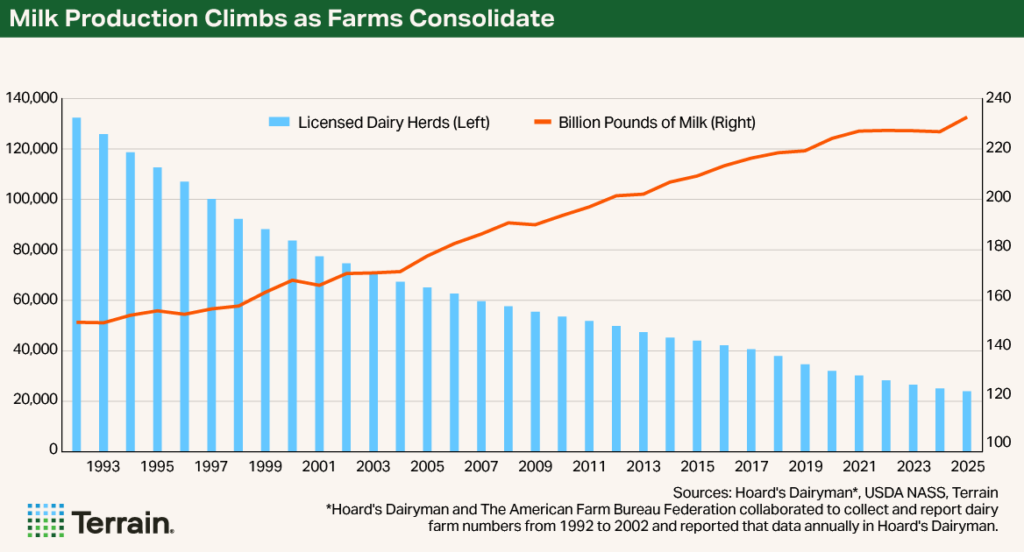
The move to fewer farms means that the remaining farms have become larger. They use different technology. They have shifted geographically. They face different challenges and respond differently to price signals and market cycles.
The shift results in a larger share of the nation’s milk coming from a smaller share of farms. As of the USDA’s 2022 Census of Agriculture, half of the dairy farms in the U.S. had fewer than 100 cows, yet those farms only represented 4% of total milk sales. Meanwhile, farms with 2,500 or more cows represented only 4% of total farms, but 45% of total milk sales.
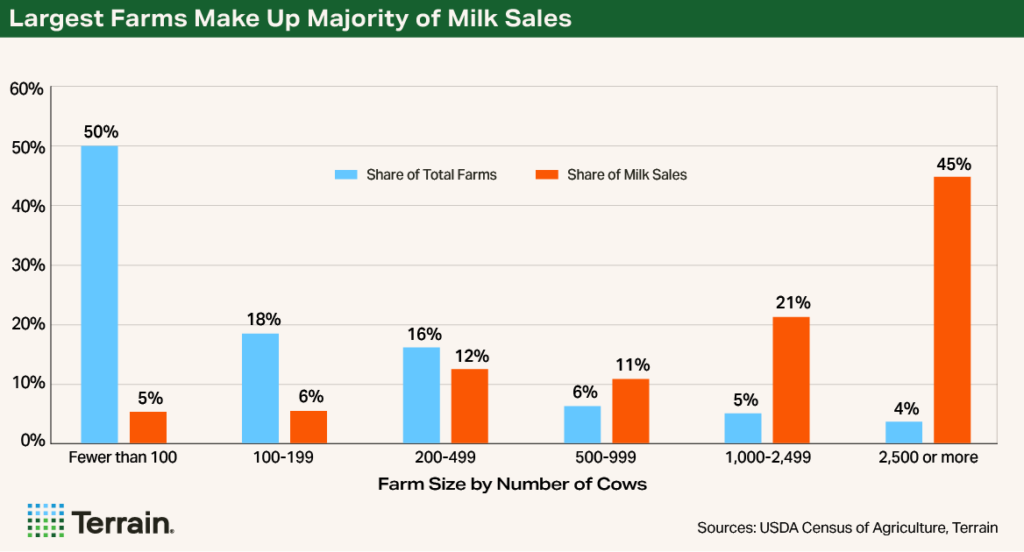
The primary driver of consolidation in the dairy industry, like many others, is the push to achieve economies of scale.
Overhead drives consolidation
The primary driver of consolidation in the dairy industry, like many others, is the push to achieve economies of scale. Larger farms are generally able to produce milk at a lower per-unit cost than their smaller counterparts. The USDA Economic Research Service used a cost frontier model to estimate economies of scale and found that across all farm sizes for which data were available, a 1% increase in milk output resulted in a cost increase of less than 1%. This suggests that the cost of production per hundredweight of milk can be reduced by increasing total production on the farm, leading to efficiency gains through economies of scale and a continual push toward larger farms as an industry.
Overhead is a key cost category that pressures smaller farms disproportionately. Dairy farms in the U.S. across a variety of sizes and geographies have become remarkably efficient at milking cows (and minimizing operating costs). But overhead can be harder to control. Larger operations are in a better position because they can spread it across higher levels of output.
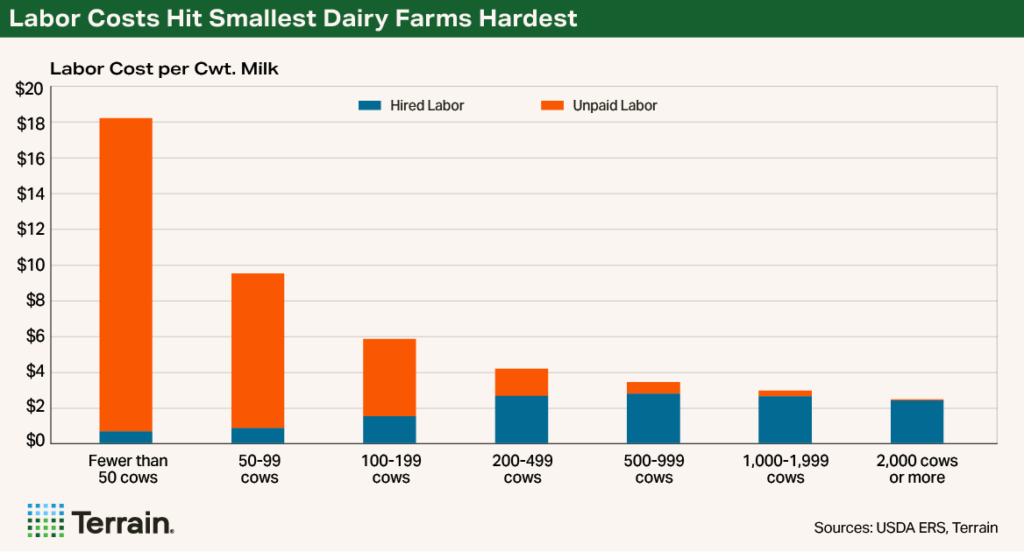
Within the overhead category, labor efficiency is one of the most important avenues for achieving efficiency as scale increases from the small end of the production spectrum.
Importantly, small farms rely disproportionately on unpaid family labor compared with hired labor. While often not accounted for, this represents a meaningful economic cost. The opportunity cost is estimated in USDA cost of production data and represents the cost of giving up the opportunity to earn income at an alternative job. For small farms with fewer than 100 cows, this typically represents 90% of total labor cost on the farm. For larger farms with more than 1,000 cows, the opportunity cost of unpaid labor is typically less than 10%.
For farms above 500 head, the labor efficiency gain becomes less dramatic once the majority of labor is hired, and the benefits of scale may appear through other technologies like parlor technology, genetic programs, dedicated heifer raising and cow tracking and monitoring.
Market consequences
As milk production becomes concentrated among fewer, larger farms, the total U.S. milk supply is likely to become less sensitive to price movements and margin pressure.
Compared with large farms, smaller farms are more likely and able to respond to near-term price movements by squeezing a few extra cows in the barn when milk prices climb, or selling a few more cull cows to aid cash flow when milk prices fall.
In today’s market, a large-scale farm may make an opportunistic expansion of 10,000 to 20,000 cows in a new facility, but then they will manage that facility within tight operational bands for several years. Farms at this scale generally won’t respond dramatically in the near term to a few favorable months of milk prices or a difficult year of margin pressure.
Size-agnostic risk management tools, like Dairy Revenue Protection (Dairy-RP), have enabled both small and large farms to take advantage of subsidized put options as risk management instruments. Combining these with in-house risk managers or outside consultants can lead to sophisticated strategies that insulate the dairy from market shocks, further reducing the responsiveness of milk supply to market movements.
With a greater proportion of the total U.S. milk supply coming from large, long-term-focused farms, total U.S. milk supply is less responsive to milk price movements than it has been historically. This means markets may see longer, and potentially more dramatic, price cycles.
Milk prices rise when the market is trying to signal that more milk is needed. If that milk supply is slower to respond, the price can remain higher for longer. Milk prices fall when the market is oversupplied, signaling that a slowdown in production is needed. The first to feel this pressure from low prices will be smaller farms with a higher break-even milk price. Larger farms with lower break-even levels and more robust risk management will be better insulated from this margin pressure and able to continue their status quo production levels for longer.
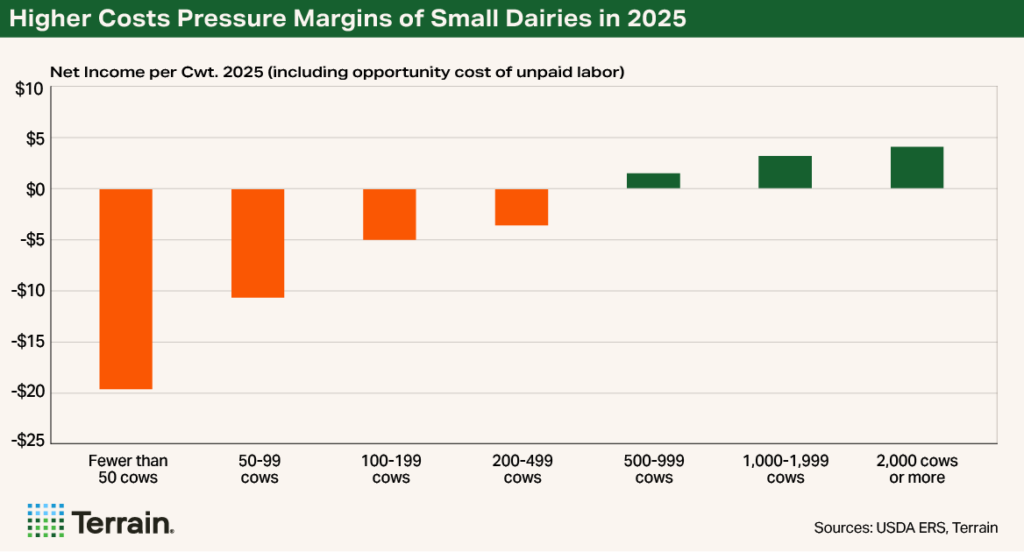
Over time, the heightened pressure on smaller farms’ margins drives them to either exit the business or grow, further fueling consolidation.
Industry structure consequences
An increase in vertical integration has developed in tandem with the consolidation in dairy farms.
When the industry landscape was defined by a large number of small farms, vertical integration was limited to opportunities for farmstead cheese production or producer-bottlers who are able to bottle and sell fluid milk from the farm.
The cooperative structure of the industry evolved out of the need for farms to focus on milk production while cooperatives could pool milk and focus on marketing, manufacturing and balancing the milk supply. As farms expanded, large-scale farms felt the limitations of this system and looked for opportunities to partner and invest in processing assets to take more control of the processing of their milk.
This is a contrast to what has been seen in other livestock sectors like pork and poultry, where processors and brands have worked backward along the supply chain to take greater control of genetics and contract with farmers to raise livestock and operate farms.
Cooperatives have historically been a means for producers to pool resources and hold equity in the marketing and manufacturing roles of the cooperative. But when a large-scale producer or small group of large producers invests directly in processing assets, they have the advantage of direct access to low-cost, high-quality, consistent milk, compared with a cooperative that must pool many smaller disparate producers.
Vertical integration can lead to efficiencies and reduce transaction costs for dairies, but it also leads to barriers to entry that reinforce consolidation. With large, vertically integrated operations, it becomes harder for new entrants (either farms or processors) to compete when they do not control multiple levels of the supply chain.
Still, alternatives remain for producers who do not want to vertically integrate. Entering direct partnerships with processors is one opportunity. Specializing and tailoring milk components to match the needs of the specific processor can strengthen these partnerships.
A successful strategy will rely on competing on dimensions other than the ability to produce commodity milk at low cost.
Paths forward at different scales
Consolidation in the U.S. milk production sector does not mean that achieving scale is the only path forward. There are feasible paths forward at various farm sizes, but a successful strategy will rely on competing on dimensions other than the ability to produce commodity milk at low cost.
Small farms
Smaller operations face higher unit costs. They often have the advantage of being closer to the end consumer and having consumer trust. Farms can leverage this through premiumization, by differentiating their milk as organic, non-GMO or grass-fed. They can also explore opportunities to bottle milk and market direct to consumers, capitalizing on local food and farm-to-table value.
Medium farms
Midsize farms are, and will likely continue to be, a difficult size to settle at. But technology and precision can enhance competitiveness. Farms this size rely more heavily on outside labor and begin to have many of the same challenges as larger farms but are not able to spread their overhead to the same degree. They may not have the scale to justify more management-level employees (in roles like personnel, herd health or purchasing), often with the primary operator taking on these responsibilities directly.
Many medium-size farms, if not seeking to expand, may find opportunity in technologies like genomics and robotics. Genomics can lead to a level of precision and accelerate genetic progress in the herd, also enabling optimization for livestock sales including beef-on-dairy. Robotics can provide dramatic improvements in labor efficiency at this scale and reduce the opportunity cost of unpaid labor.
Large farms
Farms that already have achieved significant scale and efficiency need to seek strategic competitive advantages. This will take the form of continued vertical integration. Farms may see controlling additional links in the supply chain as a form of risk management and ensuring a reliable market for their milk.
Adapting to the future
By the end of the decade, I expect there to be fewer than 20,000 dairy farms in the U.S. The absolute number of farms that exit each year may begin to slow in the medium to long term, but in the near term the combination of aging farmers and high cattle prices could accelerate exits.
Because consolidation changes how milk supply responds to markets and who holds leverage along the supply chain, producers will need to prepare to adapt accordingly. For some, achieving scale will continue to present an opportunity. For those not looking to change scale, a range of strategies exist, from differentiation to technology and precision or vertical integration.
Despite ongoing consolidation pressure, there continues to be value in a diverse milk production base in the U.S. Farms of all scales will face unique challenges and opportunities and must compete on their size-based strengths to continue evolving with the future of the industry.
Terrain® content is an exclusive offering of AgCountry Farm Credit Services, Farm Credit Services of America, Frontier Farm Credit, and American AgCredit.
While the information contained in this site is accurate to the best of our knowledge, it is presented “as is,” with no guarantee of completeness, accuracy, or timeliness, and without warranty of any kind, express or implied. None of the contents on this site should be considered to constitute investment, legal, accounting, tax, or other advice of any kind. In no event will Terrain or its affiliated Associations and their respective agents and employees be liable to you or anyone else for any decision made or action taken in reliance on the information in this site.