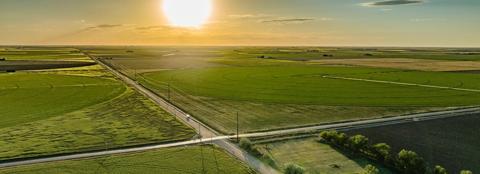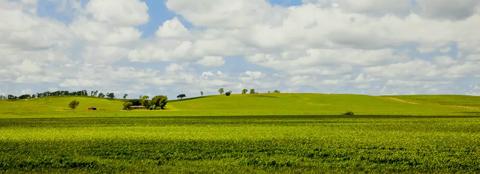

Note: This article is adapted from our previously published Sustainability Report. Content has been edited and reformatted for a blog audience, with minor updates for clarity and readability where appropriate. Customer-provided photos, used with permission.
What began with curiosity and a willingness to ask questions grew into a regenerative farming system rooted in living soil, year-round productivity, and measurable environmental and financial gains. Van Mansheim transformed his land and livelihood with the right guidance, resources, and partners.
Key takeaways
Fresh perspective drove change: Van Mansheim’s nontraditional background helped him challenge old practices.
Soil health is the core focus: Mansheim built his system around regenerative principles and continuous learning.
Multiple income streams boost returns: Crops, cattle, and hunting diversify revenue year-round.
Resilience improves wellbeing: Healthier soil reduces risk and supports long-term profitability.
A big leap into the business
On Van Mansheim’s farm, tradition doesn’t get the final say. He isn’t tied to the familiar trope, “That’s how we’ve always done it.” He sees that as one of his greatest advantages.
"I was not born and raised on a farm, and I think that is one of my strengths in our operation. I didn’t become a full-time farmer until 15 years ago.
"
Mansheim grew up in Brookings, South Dakota, built a career in sporting goods retail, and spent his weekends making the 3½-hour drive to his family’s farm in Colome, South Dakota. His plan was simple: retire at 55 and return to the farm for good. That timeline changed in 2010 when one uncle suffered a stroke, and the other could no longer keep up with the demands of the large, diversified operation. At 40, Mansheim became a full-time farmer.
“I had no farm education other than what my uncles had taught me,” he says. “But I was the type of guy who would always ask lots of questions. My uncles were really diversified with lots of income streams. They taught me a lot of the basics about the farm business.”
That business foundation—combined with a willingness to question every practice—has turned what began as a leap of necessity into a blueprint for a more profitable, resilient farm built on living roots, livestock integration, and year-round productivity.
Business-driven beginning
Once on the farm, Mansheim began attending workshops and meetings in the area. He kept hearing the same theme: soil health.
He eventually found the South Dakota Soil Health Coalition (SDSHC) and appreciated its focus on research, education, and stewardship. Today, he serves as a SDSHC board member and is now a speaker at many meetings, host for field days, and the farmer on the other end of the phone guiding the curious through soil health practices.
Mansheim’s own practices were shaped by groups such as SDSHC, neighbors, and like-minded producers. Always ready to learn, Mansheim was impressed when he heard a presentation by North Dakota farmer Gabe Brown, who was pioneering many regenerative farming practices.
“He kept talking about signing the check on the back instead of signing the check on the front because of all these practices he was doing,” Mansheim recalls. “Being a businessperson, that really intrigued me.”
Mansheim’s operation was already on a no-till path thanks to his uncles. He leaned into that and began growing cover crops in 2014 while reintroducing cattle to the farm. In 2017, he transitioned to planting into green cover crops, which allowed for more intensive grazing on both cropland and rangeland. In 2020, he started winter bale grazing.
ManBull Farming—a partnership with his brother Kirk Mansheim and nephew Heath Bullington—has evolved to include row crops, cattle production, and a pheasant hunting business.
“So many acres in this country are used for about four months out of the year; they grow a crop and then it sits idle and makes no money,” he says. “We make three different income streams off our land. We do a crop, we have a pheasant hunting business, and we run cattle.”
Mansheim admits he was hesitant to add cattle back to the operation because of the labor requirements, but he says the soil health benefits—along with new efficiencies—quickly changed his mind.
With bale grazing, they arrange hay bales on a grid and allow cattle access to a few bales at a time. This improves the soil by dispersing manure, reduces bale waste, and makes winter feeding much easier.
“We can take care of 500 head of cattle for 90 days in the wintertime and not start a tractor,” he says. “It takes about eight hours to set up 150 bales with two people. And then every time we move our fence, it only takes about an hour.”
Cut input costs
Mansheim’s crop mix includes corn, winter wheat, oats, soybeans, and alfalfa. With his focus on regenerative practices, he has greatly reduced his input costs.
“When we started this journey, we wanted to cut our synthetic fertilizer and herbicide input costs by 90% in 10 years,” he says. “Well, that’s not going to happen, but we have cut our fertilizer costs by 40% and our herbicide costs in half in 10 years. Plus, we haven’t used an insecticide since 2013, and we haven’t sprayed a fungicide on our farm in seven years.”
They also have reduced their machinery costs on the 2,500-acre operation.
"We plant four crops at four different times of the year. This allows us to have smaller equipment and spread out our workload. We plant oats in March or April. We plant corn in early May, and beans in late May. We also plant all the cover crops. We have zero tillage.
"
For Mansheim, farming is about imitating Mother Nature—not fighting her. He continues to look for ways to limit soil disturbance, diversify crops and livestock, support living plants throughout the year, and build healthier soil.
“We’ve learned a lot about soil in the last 25 years, but there’s still so much to learn,” he says. “I think mankind has done a very good job of understanding what grows above the soil, but very, very little below the soil.”
Survey shows less stress, more profit
While stress is common in farming, it may be less of an obstacle for farmers who use soil health practices versus those who farm conventionally. That’s according to a 2019 survey of farmers and ranchers conducted by South Dakota State University in partnership with the South Dakota Soil Health Coalition (SDSHC). Overall, the survey found those using sustainable production practices are optimistic about their future in farming and expect to be profitable.
"I totally agree with the survey results. I have less sleepless nights because our soils are more resilient to weather extremes.
"
Here's a snapshot of the survey results:
| Topics | Soil health producers | Conventional producers |
|---|---|---|
| Resilience to weather extremes Their systems are more resilient to drought or intense rainfall. | 80% agree | 60% agree |
| Satisfaction with farming/ranching | 71% satisfied or very satisfied | 43% satisfied or very satisfied |
| Profitability has increased | 31% agree | 12% agree |
| Confidence in reducing inputs (next three to five years) | 66% confident | 28% confident |
| Operation profitability will increase (next three to five years) | 69% agree | 36% agree |