Terrain® is our service for timely insights on topics and trends impacting agriculture, delivered by a team of specialized economic and agriculture analysts. Additional Terrain articles can be found at TerrainAg.com.
Author: Marc Rosenbohm
Report snapshot
Situation
Adoption of AI on the farm is still in its early stages, with 15% of farms reporting some level of AI usage in a recent survey. AI adoption is far more common for office work than for agronomic tasks.
Finding
AI adoption appears less connected to producer age and more closely tied to management style, scale, and willingness to test new technologies.
Impact
For farmers, the near-term opportunity may come from using AI to save time on administrative and information-intensive tasks rather than replacing agronomic decision-making. Farms that experiment early and build stronger data foundations may see more benefits over time as AI capabilities continue to improve.
Artificial intelligence is making its way onto the farm.
About 15% of farms indicate they use AI, with office tasks making up a far higher share than agronomic tasks. That’s according to survey data from Bushel’s 2026 State of the Farm Report representing over 1,400 farms across the U.S. and Canada. This year’s survey, which covered row crop farms primarily, included new questions about AI usage and adoption, offering a baseline for comparing usage among farms in subsequent years.
Whether you are among the majority of farms that have not yet experimented with AI, or are looking to expand your toolbox, the survey also reveals certain characteristics of on-farm AI usage that are worth exploring:
The age profile of current users
How AI is used
The types of AI tools used
Barriers to AI adoption
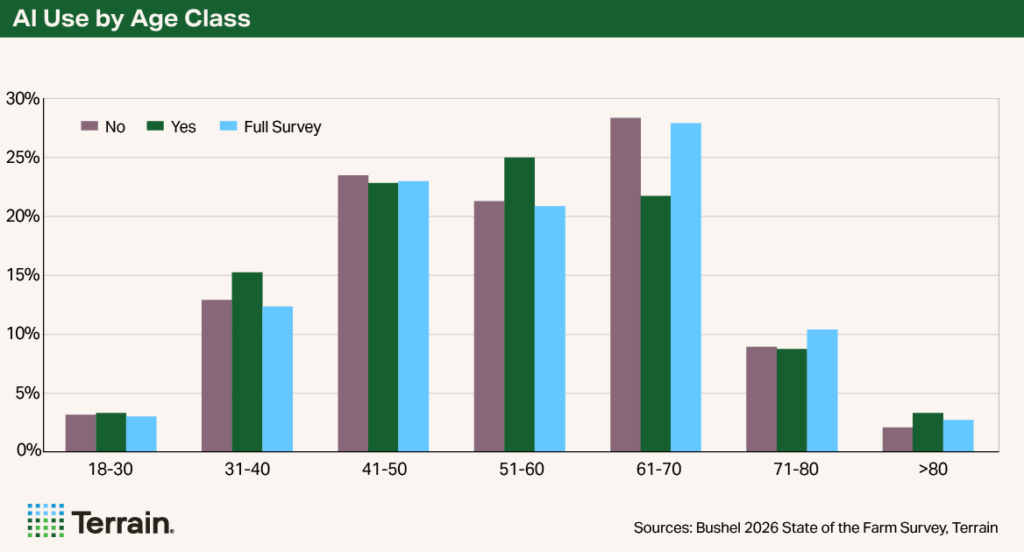
AI adoption is more reflective of how people run their farm and their disposition for trying new technology than age alone.
Reported AI usage skews slightly younger, but not by much. The weighted average age difference between the overall sample and those indicating “yes” was less than 1.5 years: 53.9 versus 55.3 years old. Most of this difference could likely be attributed to a slight underrepresentation in the 61-70 age group and a slight overrepresentation in the 31-40 age group. This suggests that AI adoption is more reflective of how people run their farm and their disposition for trying new technology than age alone.
How AI is used
Text-based uses such as drafting emails and field notes are present among all farm sizes but are much more popular as size increases. A similar trend is observable in both planning and decision-making and business or financial analysis use cases.
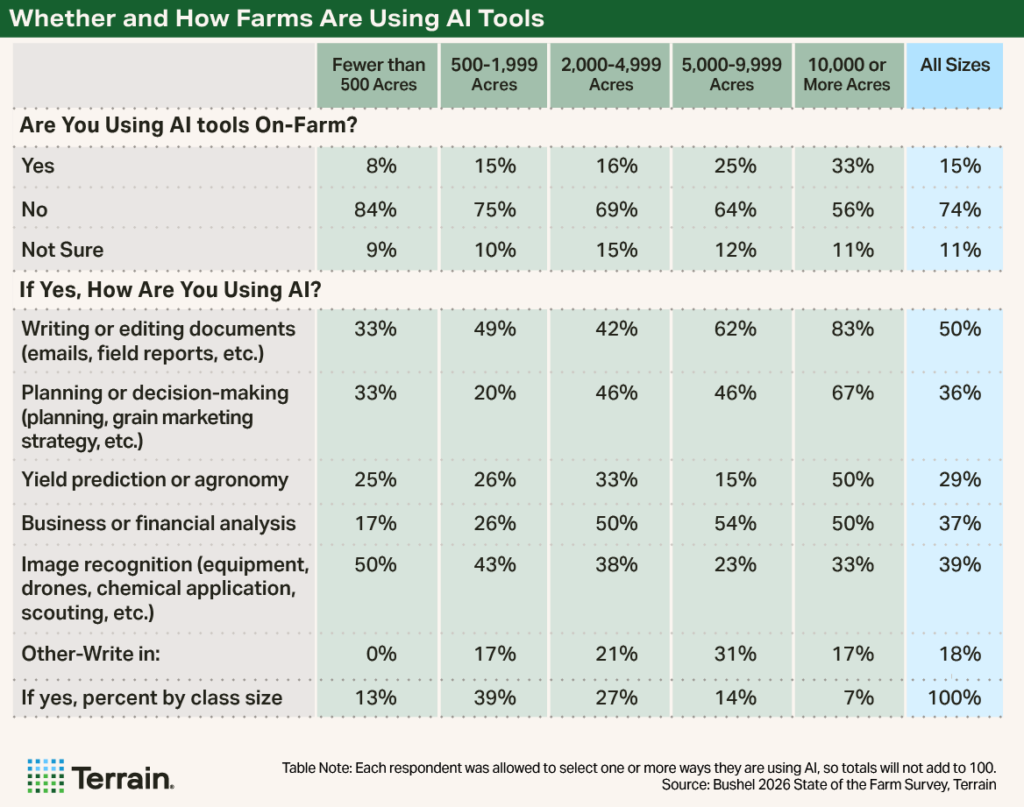
Yield prediction and agronomy use cases generally have a lower use rate among all farm sizes. While it is unclear why that is the case from the survey, this could reflect the next area of on-farm adoption or the limitations of existing data structures, or perhaps both. Image recognition, interestingly, has a higher use share among smaller farms and lower use share among larger farms.
Not all use cases fit neatly into the five available categories in the survey. Other uses written in include legal advice, meeting summaries, creating custom software tools, and advanced search. Within the advanced search use, some farms use it for answering questions or helping with complex maintenance and equipment setup.
The survey responses make it clear that larger farms report using AI tools for more farm-related tasks than smaller farms.
After this survey was conducted, Google made Gemini-powered AI features the default framework across primary search in May 2026. Consequently, more farms have likely taken advantage of this default AI-assisted search in 2026 after the Bushel survey results were collected.
Overall, even with these five use case categories, the survey responses make it clear that larger farms report using AI tools for more farm-related tasks than smaller farms, even though the sample size is somewhat limited. Among the smaller farms, there are real or perceived constraints that may need to be overcome for higher adoption.
Types of AI tools used
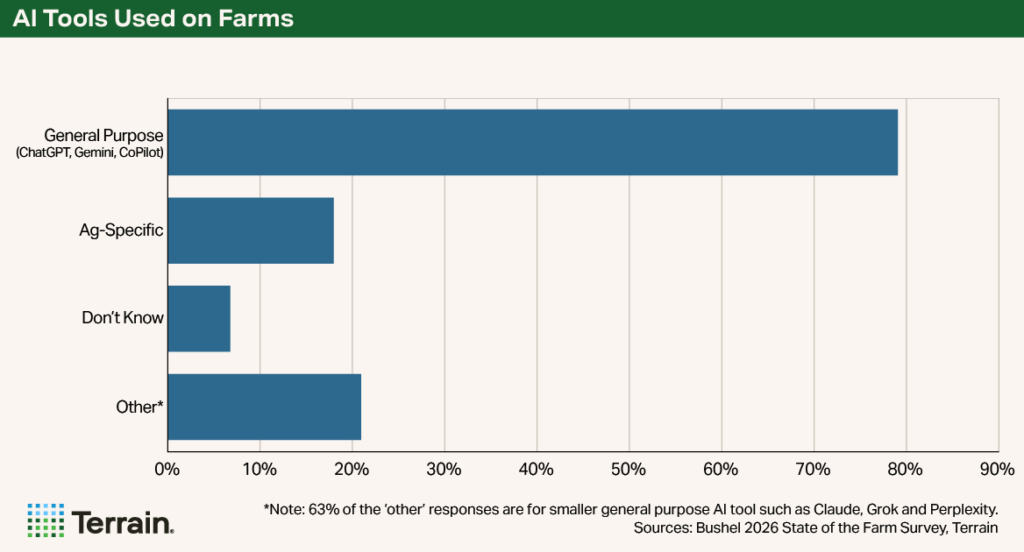
Use of general-purpose AI (for example, ChatGPT, Gemini, CoPilot) outweighed ag-specific software AI in the Bushel survey. This is likely due to the wide-scale availability and accessibility of these general AI tools, their rapid pace of advancement, their capability overlap with some agricultural-related needs, and initial affordability (often free for some level of use).
A 2026 AI & Agriculture Report by MorganMyers 1 shared a similar finding, with 48% of the 166 farmers and ranchers surveyed saying they used general-purpose AI tools with some regularity. Additionally, the 2026 Global Farmer Insights report by McKinsey & Co. confirms more farms are opting for free versions: Of the 23% of U.S. and Canadian farms reporting using generative AI tools in the survey, 10% pay for those tools and 13% rely on free tools.
Ag-specific tools have been around for a few years and include tools from seed companies, crop intelligence companies, equipment manufacturers and more. The most recent significant announcement was by John Deere, which will now have an AI assistant integrated into the John Deere Operations Center.
I expect reported ag-specific AI tool usage to increase as more companies embed AI assistants, tools or features into their platforms that are already used on the farm, or new ag-specific tools emerge. That does not mean use of general-purpose tools will fall—both can likely coexist and serve agricultural needs specific to their respective strengths.
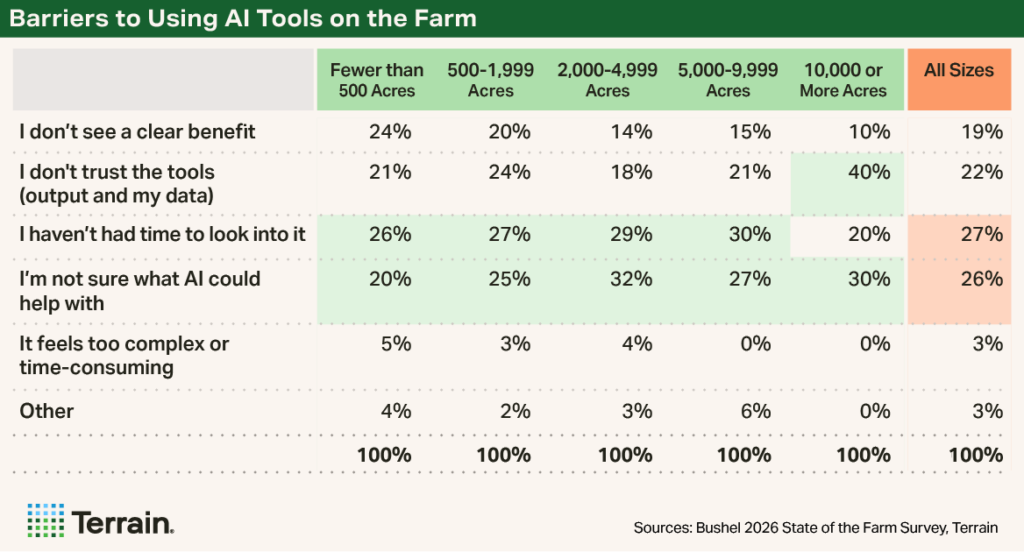
For those who have not adopted some form of AI on the farm, three themes emerge as barriers: Time, expected benefits and trust.
Barriers to AI adoption
For those who have not adopted some form of AI on the farm, three themes emerge as barriers: Time, expected benefits and trust.
For smaller and midsize farms, between 46% and 61% of respondents who said they were not using AI on their farm listed either not having time to look into it or not being sure what it could help with as the primary reason.
An individual is reported to make all the decisions on 60% or more of these size farms, reflecting a dual puzzle. The time constraint represents a hurdle to adoption for some farms, but since some AI tools offer potential time savings on a range of document or high-level analytical tasks, there could be benefits once there is time to explore these tools. That is, if the user can build trust in the output.
Similarly, in the June 2026 Purdue/CME Ag Economy Barometer survey, 52% of respondents reported “no meaningful benefit” of AI or data-driven tools to their operation. For comparison, the 2026 Bushel survey found that about 45% of those who were not using AI tools on the farm today indicated they either did not see a clear benefit or were not sure what AI could help with.
Additionally, in that Purdue survey, 85% of respondents reported that they felt the recommendations arising from data-driven tools would sometimes or often be difficult to follow. Some respondents, however, did see opportunities: Just under half of respondents thought they could reduce labor, reduce risk or uncertainty, or increase production through use of these tools.
Trust was ranked highly among the largest farms that had not adopted AI. Trust here can come in two forms: either not trusting the output or not trusting personal data to the AI tool.
In the Bushel survey, 22% of those not currently using AI tools reported trust as their primary reason for not using AI tools on-farm today.
One way to build trust in the output is to use the tool for tasks you already know very well, so you can compare its response to your existing knowledge, or for easily verifiable tasks.
Trust with data is more complex and involves understanding how the AI tool provider uses and shares data, whether that is chat data or files you uploaded for analysis.
Trust was an important theme in the MorganMyers survey, too. It reported that 37% of respondents were undecided or neutral on their level of trust of AI-generated recommendations, and an additional 39% indicated some level of distrust. The results showed AI is still viewed as promising but unproven, with perceived value high alongside distrust and skepticism. These tools need to prove their credibility to build trust with farmers. In the Bushel survey, 22% of those not currently using AI tools reported trust as their primary reason for not using AI tools on-farm today.
Bottom line
On-farm adoption of AI tools appears to be happening in the office before the field. Perhaps this is a feature of the tools readily available in the marketplace and their skills advantage. For instance, major companies like Microsoft, OpenAI and Google offer readily accessible, and often free, large language models that are good at language-based tasks and can be easily integrated into the farm office.
Trust remains a key obstacle to faster adoption. This is a broad category that encompasses everything from trusting the accuracy of answers to trusting data confidentiality and security to trusting the neutrality or impartiality of the responses. Using these tools for things you already know well and comparing the answers to your existing knowledge will be key to assessing the current trustworthiness of these tools. Testing these tools in this setting will also help you understand which topics they excel in and which areas they fall behind in.
AI tools are data-hungry, which presents great opportunities but also challenges. They have the ability to analyze large amounts of data in a structured way in a relatively short period of time, potentially offering significant time savings on one-off or repeated data-related tasks. However, to get holistic answers, they need access to sufficient data to make a fully informed decision.
Looking back at the methods of recordkeeping from last year’s report, it will likely be difficult to get holistic answers from AI tools unless a farm’s various methods of recordkeeping are accessible to and trusted to the chosen AI tools. These silos are not necessarily prohibitive, at least initially, if using AI tools for a narrow task within one area of recordkeeping such as accounting or operations.
What was best yesterday may not be what is best tomorrow, so testing out and revisiting tools may be key to finding what works best for your farm.
For the farm
It is not too late to explore how these tools might be useful on your farm. Finding where these tools fit may take some experimentation and conversations with friends, neighbors and advisors. Here are four points to consider as you explore AI on your farm:
Use it first for high-ROI administrative tasks, such as summarizing large or complex documents, comparing two or more documents, or finding specific values or texts within a document where traditional search functions might not be well suited.
For those wishing to use AI tools integrated across their whole farm, building a data structure that is clean, clear, complete and relatable across data sets will be important. Many AI tools are data-driven, so the principle of “garbage in, garbage out” applies here.
The capabilities and skills of AI tools are continually evolving, and that is likely to continue as companies race to build and integrate the best models. What was best yesterday may not be what is best tomorrow, so testing out and revisiting tools may be key to finding what works best for your farm.
The trust gap remains significant, so your judgment and validation of results or outputs will remain critical for the foreseeable future.
To read a full copy of the Bushel State of the Farm report, see: https://www.bushelpowered.com/state-of-the-farm
Exploring AI is only part of the equation. The bigger question is how new technology fits into your operation's goals, finances, and long-term plans. As you evaluate opportunities to improve efficiency and support growth, your local Farm Credit Services of America team can help you assess how they align to your financial strategy.
Endnote
1 For the MorganMyers survey, sample size, survey timing and scope are slightly different than for the Bushel survey, which could account for the higher percentage of AI users reported. In the McKinsey & Co. survey, respondents skewed slightly toward larger operations (17% were greater than 6,000 acres) than in the Bushel survey (12% over 5,000 acres), which could account for the slightly higher AI use rate, since adoption appears to be greater among larger farms.
Terrain® content is an exclusive offering of AgCountry Farm Credit Services, Farm Credit Services of America, Frontier Farm Credit, and American AgCredit.
While the information contained in this site is accurate to the best of our knowledge, it is presented “as is,” with no guarantee of completeness, accuracy, or timeliness, and without warranty of any kind, express or implied. None of the contents on this site should be considered to constitute investment, legal, accounting, tax, or other advice of any kind. In no event will Terrain or its affiliated Associations and their respective agents and employees be liable to you or anyone else for any decision made or action taken in reliance on the information in this site.